Welcome to my clinical research archive. Since 1995, researchers at independent laboratories and organizations—including the University of Virginia Division of Perceptual Studies, the Professional Division of Research at The Monroe Institute, The Rhine Research Center, and Pinelandia Biophysical Laboratory—have examined reported electrical, neurological, biophoton, and psychokinetic effects observed during studies of my abilities and demonstrations.
This page brings together published papers, laboratory observations, presentations, videos, and historical records from that research. Some projects are completed, while others have continued or developed over time. Each section identifies the researcher or institution involved and distinguishes measured observations from participant reports and proposed explanations.
Begin with the most recent work, then continue through the earlier studies to see how the research and questions have evolved.
The Work of Dr. Ross Dunseath: University of Virginia and the Professional Division of Research at The Monroe Institute
W. J. Ross Dunseath, Ph.D., is an electrical engineer and researcher whose work has included developing dry-electrode biosensors and instrumentation for combined EEG and functional MRI neuroimaging.
Dr. Dunseath has worked with the University of Virginia Division of Perceptual Studies and has served as research coordinator for the Professional Division of Research at The Monroe Institute. His research has explored altered states of consciousness, psi phenomena, neuroimaging, and instruments designed to measure unusual electrical and biofield activity.
The videos and materials in this section document research involving my brain activity, electrical responses, and intentional energy work. They include observations from studies conducted through the University of Virginia, the Professional Division of Research at The Monroe Institute, and The Rhine Research Center. Together, they provide a science-focused look at unusual patterns researchers measured during controlled sessions in which I intentionally altered my mental state or directed my energy.
University of Virginia (UVA) DOPS Laboratory Testing
EEG Preparation Inside the UVA DOPS Faraday Cage
This video documents preparations for one of the EEG research sessions conducted with Dr. Ross Dunseath at the University of Virginia Division of Perceptual Studies. The laboratory team connects the monitoring equipment while I am seated inside a Faraday cage, an enclosure used to reduce outside electromagnetic interference during sensitive measurements.
This video shows one of many laboratory sessions conducted during an approximately year-and-a-half pilot research program with Dr. Ross Dunseath. The EEG data accumulated across those sessions contributed to the ideas and conclusions he later discussed about how my brain appeared to operate during intentional psychokinetic activity.
In the Shattered Realities interview, Dr. Dunseath describes activity observed across multiple brainwave frequency bands, including simultaneous alpha- and theta-range activity. His interpretation was based on patterns he observed across the broader series of studies; this short video provides a behind-the-scenes view of how some of that underlying data was collected.
25-to-5,000-Volt Scale Electrostatic Field Test Near My Fingertips — UVA Laboratory
During this University of Virginia laboratory session, Dr. Ross Dunseath used an electrostatic-field detector to examine electrical-field changes near my fingertips. The instrument showed substantial deflections while my fingers remained approximately one-half inch to one inch from the sensor, without touching it. The displayed readings varied as the detector’s scale and the distance from my hand were changed.
Dr. Dunseath compared my response with his own hand under similar conditions and observed a much smaller deflection. He stated that he did not believe ordinary static charge adequately explained what the instrument was detecting, while also remaining appropriately cautious about its source. When I suggested that I was generating the effect with my brain, he replied that I was generating it “with something,” but that the experiment did not establish whether the brain was responsible.
This video documents an exploratory laboratory observation, not a final determination of the mechanism. Further controlled testing would be needed to identify the source of the detected field, rule out environmental and instrumental factors, and determine how the readings relate—if at all—to the sensations people have reported during my demonstrations.
CASE STUDY: Energy Body Research at The Monroe Institute
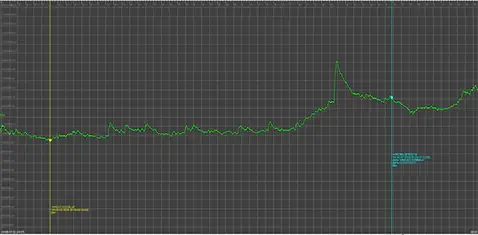
Fig. 4: E-field response during Edd Edwards energy session. Yellow line marks lowest field level. Difference from low point to peak is 0.86 volts. Blue line marks point the Edd stopped. Time is 10 seconds per grid line.
About the Researcher
W. J. Ross Dunseath, Ph.D. is an electrical engineer and consciousness researcher whose work has included neurofeedback instrumentation, physiological monitoring, high-density EEG systems, and combined EEG and functional MRI imaging. He joined the University of Virginia Division of Perceptual Studies in 2010 and has worked with the Westphal Neuroimaging Laboratory.
As research coordinator for the Professional Division of Research at The Monroe Institute, Dr. Dunseath has helped develop the Copper Wall facility and its methods for measuring quasi-static electrical fields around the human body under controlled conditions.
Featured article: Quasi-static Electric Fields of the Human Body: Copper Wall Research at The Monroe Institute — November 6, 2023
Quasi-static Electric Fields of the Human Body: Copper Wall Research at the Monroe Institute
Summary of Case 3, reported by Ross Dunseath, Ph.D.: During this session, a participant stood inside the Copper Wall Room with eyes closed while I stood approximately 20 feet away and directed my intention toward the participant. Dr. Dunseath reported that the participant’s electric-field signal rose from a stable baseline, reached a peak, and later dropped at the point when I stopped. The participant described feeling charged and discharged, followed by an overall sense of being energized.
Dr. Dunseath discussed the observation as a possible example of distant mental intention on a living system, while leaving the mechanism unresolved and calling for further study.
“It was quite the experience to see the field level drop off the second Edd stopped his energy intention.”
— Ross Dunseath, Ph.D., Monroe Research Coordinator
Read Dr. Dunseath’s complete November 2023 Monroe Institute case study.
Summary
These findings raise important questions. There is currently no accepted physiological mechanism for generation of large, transient body voltages on the order of tens of volts. Focused application of these fields has been associated with beneficial outcomes such as pain reduction and subjective healing. In some instances the effects appear to occur across distances or with shielding that would rule out a simple electric-field carrier, suggesting the possibility of an additional, as-yet-uncharacterized process. Measuring anomalous body electric activity is the crucial first step toward clarifying mechanisms and clinical relevance, and further rigorous study is a high priority.
Ross Dunseath TMI Research Coordinator May 17, 2018
Live Copper Wall Measurements with Laura J Rinaolo — The Monroe Institute
This video documents a research session conducted through the Professional Division of Research at The Monroe Institute. Laura J Rinaolo is connected to the Copper Wall instrumentation while Dr. Ross Dunseath observes the measurements and comments in real time on changes appearing in the electrical-field data. The footage preserves what Dr. Dunseath and the research team were seeing during the session. His remarks describe the instrument response as it occurred; the broader meaning and possible mechanism of those observations remained subjects for continued study.Helping Build the Copper Wall Array Laboratory — The Monroe Institute
This behind-the-scenes video documents my work with Dr. Ross Dunseath as we helped build and prepare the Copper Wall Array laboratory for the Professional Division of Research at The Monroe Institute.
The facility was modeled on the Copper Wall measurement approach developed by Elmer Green and his research team at the Menninger Foundation. Its purpose is to measure quasi-static electrical fields around the human body under controlled conditions while reducing and identifying environmental interference. This construction footage documents the development of the research facility; findings from studies conducted there are presented separately.
Rhine Research Center: Bio Photon Lab
My December 2014 Bio Photon Lab Session — Rhine Research Center
I began participating in research at the Rhine Research Center in 2008. This video documents a laboratory session conducted on December 7, 2014, using the Bioenergy Laboratory’s sensitive equipment to examine low-level light emissions and possible psychokinetic effects during focused intention.
The footage records the testing process and the conditions used by the research team. It should be viewed as documentation of an individual laboratory session; any findings depend on the recorded measurements, controls, and the researchers’ analysis.
Healing, Biophotons, and Psychokinesis — John G. Kruth
In this presentation, John G. Kruth explains the Rhine Research Center’s continuing investigation of energy-healing practices, biophoton emissions, and intentional and unintentional psychokinesis. He discusses the laboratory’s methods, the questions guiding its experiments, and the possible relationships among reported healing effects, human light emissions, and PK phenomena.
Kruth is executive director of the Rhine Research Center and founder of the Rhine Education Center. His presentation provides the broader research context for the individual laboratory sessions and materials featured in this section; it does not, by itself, establish a single mechanism or universal result.
Subtle Energies and Biophotons
John G. Kruth continued the work of Bill Joines and Steve Baumann, who established the Bioenergy Laboratory at the Rhine Research Center in the early 2000s. The laboratory uses sensitive light-detection equipment in complete darkness and an electromagnetically shielded room to examine ultraweak photon emissions and other detector responses during focused intention, meditation, and energy-healing practices.
More than 100 volunteers—including energy practitioners, meditators, martial artists, and people reporting no special ability—have participated in the laboratory’s measurements. In his presentation, Kruth reports that four individuals and three meditation groups produced readings reaching as high as one million counts per second, compared with typical background readings below ten counts per second. He reports that the elevated counts began during focused practice and subsided after the activity ended.
I have also participated in this research and was reported to produce unusually high detector counts during laboratory sessions. These observations are instrument readings obtained under experimental conditions; their biological source, physical meaning, and relationship to reported experiences remain subjects of investigation.
Kruth has also reported elevated readings in some tests when the light sensor was capped. That result led the research team to consider several possibilities, including detector behavior, unidentified artifacts, or a possible psychokinetic influence on the instrument. The capped-sensor observations do not, by themselves, establish which explanation is correct.
Study on Healer Edd Edwards at the Rhine Research Center, August 2019
In August 2019, Judith Pennington conducted a preliminary Mind Mirror EEG study at the Rhine Research Center while I performed a ten-minute energy session with her. The report describes my brainwave activity across delta, theta, alpha, beta, and low-, mid-, and upper-gamma frequencies, including unusually high coherence and high eyes-open scores in the Mind Mirror’s Awakened Mind, Evolved Mind, and Gamma Synchrony measures.
Pennington reported that her own low-gamma coherence and other EEG patterns changed during the session. She interpreted portions of the data as consistent with a transfer of high-frequency gamma from me to her. The report also identifies persistent 60-hertz electrical noise caused by a likely hookup problem and states that her statistical gamma-range percentages were unreliable and should be discounted. The source and meaning of the remaining observed changes therefore require further controlled study.
Pennington also reported that chronic low-back pain she had experienced for more than forty-five years was absent after the session and remained absent five weeks later, when the preliminary report was written. This was a participant-reported outcome from a single session, not a clinical finding. The report also notes that John G. Kruth, executive director of the Rhine Research Center, collected photomultiplier measurements for separate analysis.
Full Research Report: Preliminary Mind Mirror Study of Edd Edwards
This embedded document is Judith Pennington’s complete thirty-three-page preliminary report on the Mind Mirror EEG session conducted with me at the Rhine Research Center on August 17, 2019. It contains the session background, time-stamped EEG displays, summary plots, coherence analyses, Pennington’s reported experiences, and her interpretations and conclusions. The report should be read as the author’s account of a single exploratory session, including the limitations and electrical-noise issue she identifies.
Powered By EmbedPress
Early Research: Pinelandia Biophysical Laboratory and ELFRAD, 1994–2008
Scientific investigation of my reported abilities began in 1994 at Pinelandia Biophysical Laboratory with biophysicist W. C. Levengood and researcher John Gedye. Their experiments examined electrical and biological responses recorded during demonstrations in which I intentionally directed my energy or attention.
Levengood and Gedye developed explanations involving charged-density pulses, biological electrical activity, and possible interaction between the autonomic nervous system and resonant processes in living systems. These were the researchers’ proposed mechanisms for the observations; they should not be treated as established explanations without further independent testing and replication.
Published papers
- “Evidence for Charged Density Pulses Associated with Bio Electric Fields in Living Organisms” — Subtle Energies & Energy Medicine, 1997
- “Mechanisms Related to Charge Density Pulse Formation in Living Systems” — Subtle Energies & Energy Medicine, 2002
ELFRAD Group recordings, 1997–2002
Charlie Plyler and the ELFRAD Group, working in coordination with Pinelandia, recorded time-correlated data during experiments involving focused intention and reported nonlocal events. These recordings form part of the historical research record. Their interpretation depends on the original methods, timestamps, controls, and datasets, and they should not be treated as independent confirmation of a mechanism without those supporting records.